



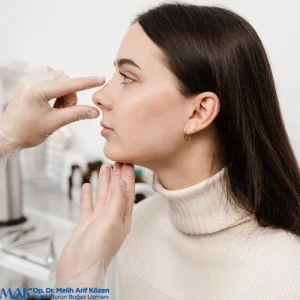
Ear, Nose & Throat specialist Op. Dr. Melih Arif Közen, who practices in İzmir, offers a meticulous approach to revision rhinoplasty (secondary rhinoplasty) for correcting cases in which a previous nasal surgery did not achieve the desired result. Revision rhinoplasty is a procedure in which aesthetic or functional problems remaining from the previous surgery are corrected; it is more delicate than the initial surgery and requires considerable experience.
Because the tissues change after the first surgery, cartilage support may decrease, and scar tissue can form, revision surgery requires more careful planning. The goal is not only to improve appearance, but to achieve a natural and balanced result by also addressing any breathing problems.
For revision, it is generally recommended to wait at least 6–12 months after the first surgery. This period is necessary for the tissues to settle; early intervention may negatively affect the outcome.
What Is Revision Rhinoplasty?
Revision rhinoplasty (secondary rhinoplasty) is a secondary surgical procedure in which aesthetic or functional problems remaining after a previous nasal surgery are corrected. Because the tissues have changed, cartilage support has decreased, and scar tissue has formed, it requires more careful planning.
Shape Correction
Asymmetry, collapse, or an undesirable nasal tip remaining after the first surgery is reshaped to achieve a balanced form.
Function Repair
Breathing difficulty and internal structural problems caused by the previous surgery are corrected to ease respiration.
Tissue Support
Diminished cartilage support is reinforced when necessary with grafts from the ear or rib cartilage to provide a lasting structure.
In Which Cases Is Revision Rhinoplasty Performed?
Revision comes into consideration when aesthetic or functional expectations are not met after the first surgery. The most commonly assessed reasons are as follows.
Aesthetic Problems
Appearance-related issues such as irregularity of the nasal dorsum, asymmetry, or a nasal tip that is over-reduced or drooping.
Functional Problems
Nasal obstruction, breathing difficulty, and internal nasal narrowing caused by the previous surgery.
Changes Related to Healing
Collapse, deviation, or shape deformities that develop over time due to scar tissue.
Not every dissatisfaction requires surgery. Some minor irregularities can also be corrected with non-surgical methods such as fillers.
Which Techniques Are Used in Revision Rhinoplasty?
The technique to be used is determined by the extent of the previous surgery, the current condition of the tissue and cartilage, and the problem that needs to be corrected.
Open Revision Rhinoplasty
The structure is reached directly through an incision at the nasal tip. It is the most controlled method, preferred for complex corrections and cases with extensive scar tissue.
Graft-Supported Repair
Diminished cartilage support is reinforced with grafts taken from the ear or rib cartilage, and collapsed areas are reconstructed.
Non-Surgical Correction
Minor irregularities and mild asymmetries can be corrected in suitable cases with non-surgical methods such as fillers.
In revision, cartilage grafts are often needed. Because these grafts fully integrate with the tissue, they are taken from the person’s own ear or rib.
Preparation Before Revision Rhinoplasty
Revision surgery requires a more detailed evaluation than the initial surgery. A safe plan is created by carefully considering the history of the previous surgery, the condition of the tissue, and the patient’s expectations.
Detailed Examination and Planning
The nasal structure, cartilage support, and scar tissue are assessed. Imaging is performed if necessary, and a personalized plan is created.
General Health Check
Blood tests are performed; medications, smoking, and blood thinners are reviewed. Additional evaluation may be carried out since a graft may be needed.
How Is Revision Rhinoplasty Surgery Performed?
Revision rhinoplasty is performed under general anesthesia and, depending on the extent of the procedure, may take longer than the initial surgery. Because of scar tissue, it requires more careful work; the process proceeds in defined stages.
Anesthesia and Assessment
The patient is put to sleep, the area is sterilized, and the scar tissue from the previous surgery along with the current structure is assessed in place.
Repair and Grafting
The scar tissue is reshaped, and support is provided with grafts when necessary. Shape and function are reconstructed together.
Closure and Fixation
The incisions are sutured, and if necessary, packing and an external protective splint are applied. The patient is discharged after a short follow-up.
Let’s Determine the Right Solution for Your Nose Together
If you are not satisfied with the result of your previous surgery, you can consult Op. Dr. Melih Arif Közen to learn about your revision options.
Recovery Process After Revision Rhinoplasty
Recovery after revision is a process that extends over time; because of scar tissue, swelling may last a little longer. The swelling and bruising in the first days are normal and gradually subside.
First Week
The splint and any packing are removed within 5–7 days. Swelling and bruising may occur around the eyes; the head should be kept elevated and cold compresses applied.
Following Months
Noticeable swelling subsides within a few weeks. The final result takes longer to fully settle than after the first surgery, often more than 12 months.
Consult your physician without delay in the following situations:
- Persistent or increasing nosebleed
- High fever and progressively worsening severe pain
- Marked redness, discharge, or swelling at the surgical site
- Increasing pain or swelling at the graft donor site
Related Treatments
Frequently Asked Questions
How long after the first surgery can revision be performed?
It is generally recommended to wait at least 6–12 months after the first surgery. This period is necessary for the tissues to fully settle and the swelling to subside. An intervention performed too early may negatively affect the outcome because of tissues that have not yet healed.
Is revision surgery more difficult than the first surgery?
Yes, revision rhinoplasty is technically more challenging. Because of scar tissue, diminished cartilage support, and altered anatomy, it requires more careful planning and experience. For this reason, it is important that it be performed by an experienced surgeon.
Why are grafts used in revision?
Cartilage support may have decreased during the first surgery. Grafts taken from the ear or rib cartilage are used to reconstruct collapsed or weakened areas. Because these grafts are taken from the person’s own body, they fully integrate with the tissue.
Is surgery necessary for every dissatisfaction?
No. Minor irregularities and mild asymmetries can be corrected in suitable cases with non-surgical methods such as fillers. Whether surgery is needed is determined after a detailed examination.
When will I see the final result after revision?
Although noticeable swelling subsides within a few weeks, the final result takes longer to fully settle in revision surgeries than after the first surgery; this period can often exceed 12 months. It is important to be patient during this process.