



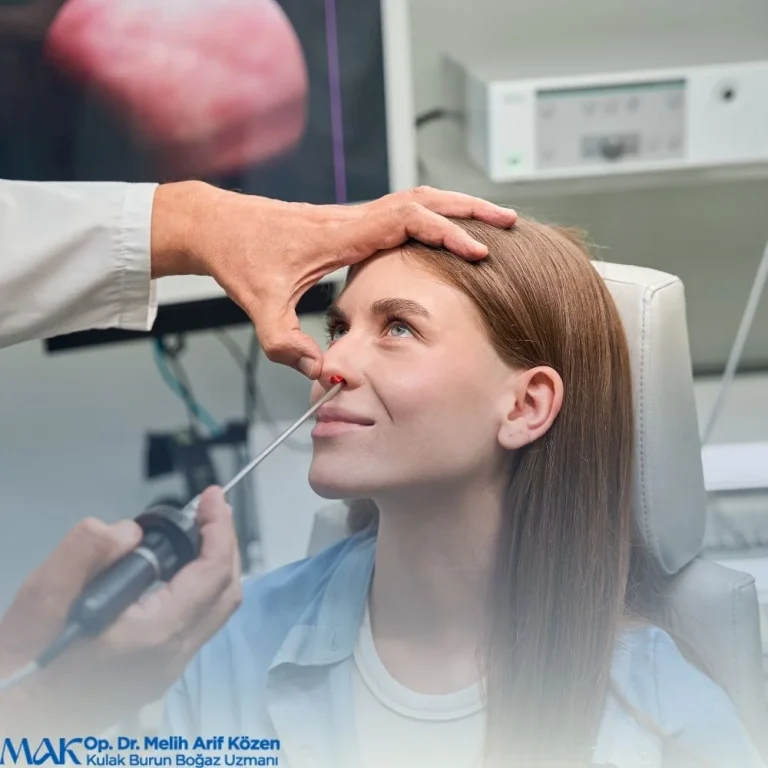
Ear, Nose & Throat specialist Op. Dr. Melih Arif Közen, practicing in İzmir, performs modern endoscopic sinus surgery (FESS) techniques to restore the ventilation and natural drainage of the sinuses in chronic sinusitis cases that do not respond to medical therapy. Endoscopic sinus surgery is a closed procedure performed through the nose under camera guidance, with no external incision.
Sinusitis is the inflammation of the mucosa lining the sinus cavities, leading to complaints such as nasal congestion, a sensation of facial pressure, postnasal drip and loss of smell. When these complaints persist for more than 12 weeks, the condition is called chronic sinusitis. Surgery becomes an option when medication and spray treatments prove insufficient and the congestion is due to structural causes.
Sinusitis is frequently accompanied by a deviated septum or enlarged turbinates. In such cases, sinus surgery can be performed together with the correction of these problems in the same session.
What Is Endoscopic Sinus Surgery?
Endoscopic sinus surgery (FESS) is a closed procedure in which a thin camera (endoscope) is introduced through the nose to widen the sinus openings and clear away the tissues causing the obstruction. The aim is not to empty the sinuses completely, but to reopen the natural ventilation and drainage pathways.
Opening the Drainage Pathway
The blocked sinus openings are widened, allowing the accumulated inflamed secretions to drain and the sinus to be ventilated.
Clearing the Diseased Tissue
Polyps, thickened mucosa or any tissue causing obstruction are precisely cleared under camera guidance.
A Scar-Free Method
Because the entire procedure is carried out through the nose, no externally visible incision scar remains on the face or nose.
In Which Cases Is Sinus Surgery Performed?
Endoscopic sinus surgery becomes an option when medication and spray treatments are insufficient, when complaints recur, or when structural causes are present. The most commonly assessed reasons are as follows.
Chronic Sinusitis
Nasal congestion, postnasal drip and a sensation of facial pressure that last longer than 12 weeks and do not respond to medical therapy.
Nasal Polyps
Benign masses that grow within the nose and sinuses, blocking the airway and leading to loss of smell and recurrent infections.
Structural Obstructions
Anatomical narrowings that constrict the sinus openings, along with frequently recurring infections that persist despite antibiotics.
The cause of nasal congestion is not always the sinuses. A deviated septum or enlarged turbinates can produce similar complaints; an accurate diagnosis is made through a detailed examination.
Which Methods Are Used in Sinus Surgery?
The method to be used is determined by the extent of the disease, which sinuses are affected and any accompanying structural problems. The main approaches are as follows.
FESS (Functional Endoscopic Sinus Surgery)
This is the standard method. Under camera guidance, the sinus openings are widened, diseased tissue is cleared and the natural drainage pathways are reopened.
Balloon Sinuplasty
A less invasive method used in suitable cases, in which the sinus opening is widened with a small balloon. Drainage is achieved without removing tissue.
Concurrent Corrections
When needed, septoplasty or turbinate reduction is performed in the same session, so that nasal congestion is fully resolved.
Preparation Before Sinus Surgery
A successful sinus surgery begins with an accurate diagnosis and a detailed preoperative assessment. At this stage, the extent of the disease is determined and the necessary checks are carried out to ensure the operation proceeds safely.
Examination and Imaging
Through endoscopic nasal examination and a sinus CT scan, the affected sinuses and any accompanying structural problems are identified, and a plan is established.
General Health Check
Blood tests are performed; current medications, smoking and blood thinners are reviewed. If there is an active infection, it is brought under control first.
How Is Sinus Surgery Performed?
Endoscopic sinus surgery is performed through the nose under general anesthesia and, depending on the extent of the disease, usually takes 1–2 hours. Because there is no external incision, the process is comfortable for the patient and proceeds through defined stages.
Anesthesia and Imaging
The patient is placed under general anesthesia. The endoscope is inserted into the nose and the sinus openings are visualized under camera guidance.
Opening and Clearing
The blocked sinus openings are widened; polyps, thickened mucosa and diseased tissue are precisely cleared, and the drainage pathways are opened.
Completion
If necessary, a dissolvable nasal packing is placed inside the nose. If an accompanying septum or turbinate correction is required, it is completed in the same session, and the patient is discharged after a short follow-up.
Let Us Determine the Right Solution for Your Sinus Complaints
For your recurrent sinusitis and nasal congestion complaints, you can consult with Op. Dr. Melih Arif Közen.
The Recovery Process After Sinus Surgery
Recovery after endoscopic sinus surgery is generally comfortable. In the first few days, mild nasal congestion, watery discharge and postnasal drip may occur; these are normal and gradually subside. Following the nasal care instructions speeds up recovery.
The First Week
If present, the dissolvable packing breaks down within a short time. Crusting may occur inside the nose; regular rinsing with the saline spray recommended by your doctor is important during this period.
The Following Weeks
Most patients return to their daily life within a few days. Full healing of the inside of the nose and complete resolution of complaints may take a few weeks.
Consult your doctor without delay in the following situations:
- Persistent or heavy nosebleeds
- High fever and progressively worsening severe pain
- Blurred vision or marked swelling around the eye
- Severe, persistent headache
Frequently Asked Questions
Will sinusitis surgery leave a scar on my face?
No. Endoscopic sinus surgery is performed entirely through the nose, under camera guidance. Because there is no external incision, no visible scar remains on the face or nose.
Is the surgery painful, and does recovery take a long time?
Because the procedure is performed under general anesthesia, no pain is felt. Afterwards, there may be mild congestion and a feeling of pressure; most patients return to their daily life within a few days.
Does sinusitis recur after surgery?
Surgery restores the ventilation and drainage of the sinuses. When the doctor’s recommendations and nasal care are followed, complaints largely resolve; however, underlying causes such as allergies should be kept under control.
Is my nasal congestion caused by the sinuses?
Not always. Congestion can also be caused by a deviated septum or enlarged turbinates. An accurate diagnosis is made through endoscopic examination and, if necessary, a CT scan.