



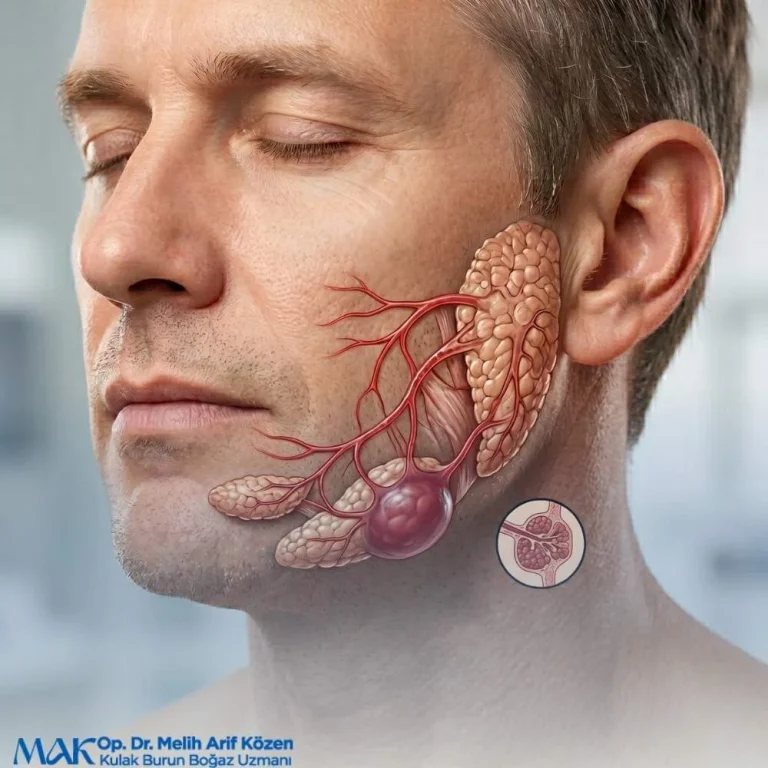
Based in İzmir, Ear, Nose and Throat specialist Op. Dr. Melih Arif Közen performs parotidectomy surgery, the surgical treatment of masses that develop in the parotid gland, the largest salivary gland in the facial region. The parotid gland is an important gland located on each side, just in front of and below the ear, that secretes saliva into the mouth. Because the facial nerve passes through this gland, the surgery requires meticulous care and experience.
The vast majority of masses that develop in the parotid gland are benign; however, some may be malignant (cancerous). For this reason, it is important to evaluate any mass in the gland that is noticed, growing, or hardening. Parotidectomy is the surgery in which part or all of the gland tissue is removed together with the mass, in order both to establish a diagnosis and to provide treatment. The most critical point during the procedure is preserving the facial nerve.
Early diagnosis and the correct surgical approach form the basis of successful outcomes for both benign and malignant masses. For this reason, the surgery should be performed by an experienced surgeon who is well versed in facial nerve anatomy, using modern nerve preservation techniques. The aim is to remove the mass safely while preserving facial movement and appearance.
Masses in the parotid gland are usually painless and grow slowly. For this reason, they may take time to be noticed. Any swelling felt in front of the ear or at the angle of the jaw that gradually grows should always be evaluated by a specialist.
What Is Parotidectomy?
Parotidectomy is the surgical procedure in which masses developing in the parotid (salivary) gland are removed together with part or all of the gland. The extent of the surgery is determined by the location and size of the mass and by whether it is benign or malignant. For masses in the superficial part of the gland, usually only that portion of the gland is removed, whereas deeply located or malignant masses may require more extensive surgery. Throughout all of these procedures, the primary priority is preserving the facial nerve that passes through the gland.
Removal of the Mass
The mass that develops in the gland is removed with safe margins together with the surrounding healthy tissue. This both confirms the diagnosis and provides treatment. The removed tissue is sent for detailed pathological examination.
Preservation of the Facial Nerve
The facial nerve, which controls the facial expression muscles, passes through the parotid gland. The most critical stage of the surgery is carefully locating and preserving this nerve so that facial movement is maintained.
Definitive Diagnosis
The pathological examination of the removed mass definitively reveals whether the mass is benign or malignant. This result also guides the subsequent treatment plan when necessary.
In modern parotidectomy, techniques such as nerve monitoring, which tracks the facial nerve during surgery, may be used. These methods aim to minimize the risk of facial paralysis by helping to preserve the nerve. The extent and technique of the surgery are planned individually for each patient after detailed examination and imaging.
When Is Parotidectomy Performed?
Parotidectomy is performed to evaluate and treat masses detected in the parotid gland. Whether the mass is benign or malignant, its size, and the complaints it causes are decisive in the decision to operate. The most commonly evaluated situations are as follows.
Benign Tumors
Most masses in the parotid gland are benign. However, over time they can grow, put pressure on surrounding tissues, and rarely transform into a malignancy. For this reason, their removal is usually recommended.
Malignant Tumors
Surgical treatment is required for masses that are suspected of being cancerous or that grow rapidly, harden, or cause pain, as well as for cases showing adhesion to the skin or facial nerve.
Recurrent Problems
Surgery may also be considered for persistent problems that do not respond to other treatments, such as recurrent inflammation, stone formation, or cystic structures in the gland.
There are certain signs that suggest a mass may be malignant: rapid growth, hardness, pain, skin changes, or weakening of facial movement are among the foremost. Such findings require a more comprehensive preoperative evaluation. Nevertheless, a definitive diagnosis can only be made through the pathological examination of the removed tissue.
Some benign masses (for example, pleomorphic adenoma) may transform into a malignancy over many years if they are not removed. For this reason, even for masses considered “benign,” surgical removal is recommended in appropriate cases.
How Is Parotidectomy Performed?
The method used in parotidectomy is determined by the location and size of the mass, its relationship to the facial nerve, and whether it is benign or malignant. The common goal is to remove the mass safely while preserving the facial nerve. The main approaches used are as follows.
Superficial Parotidectomy
If the mass is in the superficial part of the gland, outside the facial nerve, only this portion is removed. It is the most commonly performed method for benign masses and the one in which the nerve is fully preserved.
Total Parotidectomy
If the mass is in the deep part of the gland or is malignant, the entire gland may be removed. In this case as well, every effort is made to carefully preserve the facial nerve; nerve monitoring is used if necessary.
Extended Surgery
For malignant and spreading tumors, the surgical scope is extended, with the neck lymph nodes also evaluated if necessary. The treatment plan is determined in a multidisciplinary manner.
The choice of method is based on the preoperative examination, imaging, and, when necessary, needle biopsy results. In all approaches, the incision is generally planned to start in front of the ear and follow the natural folds; in this way, the scar becomes as inconspicuous as possible after recovery. The surgeon’s experience and modern techniques are decisive for both oncological success and aesthetic outcome.
Preparation Before Parotidectomy
Because parotidectomy is a surgery that is close to the facial nerve and requires meticulous care, the detailed evaluation performed beforehand is of great importance for both accurate surgical planning and safety. At this stage, the characteristics of the mass are determined and the appropriate approach for the patient is planned.
Examination and Imaging
Following the neck and facial examination, the location and size of the mass and its relationship to the facial nerve are evaluated by ultrasound, MRI, or CT. When necessary, preliminary information about the mass is obtained through a fine-needle biopsy, so the extent of the surgery can be planned in advance.
General Health Check
The necessary blood tests and evaluations are performed before anesthesia. Medications, especially blood thinners, are reviewed. The patient’s general health condition is addressed in detail to ensure the surgery proceeds safely.
During this preparation process, the patient is informed in detail about the extent of the surgery, the measures taken to preserve the facial nerve, and the possible risks. A clear understanding of the process from the outset both reduces the patient’s anxiety and ensures realistic expectations after surgery.
How Is Parotidectomy Surgery Carried Out?
Parotidectomy is performed under general anesthesia, and its duration varies according to the extent of the mass. The most important feature of the surgery is that it is carried out by locating and preserving the facial nerve. For this reason, the procedure proceeds in a controlled manner through specific stages that require care and experience.
Anesthesia and Incision
The patient is put to sleep under general anesthesia. The gland is reached through an incision that usually starts in front of the ear and follows the natural skin folds; in this way, the scar remains as inconspicuous as possible after recovery.
Locating the Facial Nerve
The facial nerve that passes through the gland is carefully located and preserved by tracing it along its branches. When necessary, nerve monitoring is used to track the integrity of the nerve throughout the surgery.
Removal of the Mass and Closure
The mass is removed with safe margins together with the appropriate surrounding tissue and is sent for pathological examination. The area is checked and closed; a temporary drain is placed if necessary.
Proper Evaluation for Salivary Gland Masses
You can consult Op. Dr. Melih Arif Közen about any swelling you notice in front of your ear or at the angle of your jaw.
Recovery Process After Parotidectomy
Recovery after parotidectomy varies according to the extent of the surgery but generally follows a steady course. In the first few days, there may be mild swelling, tightness, and a feeling of numbness in the surgical area; these decrease over time. In surgeries where the facial nerve is preserved, facial movement is usually normal; however, mild weakness that resolves on its own may sometimes be seen due to temporary effects on the nerve.
The First Days
There may be swelling and tenderness in the surgical area. If present, the drain is removed within a short time. During this period, caring for the sutures, keeping the area clean, and following the physician’s recommendations speed up recovery.
The Later Process
Most patients return to their daily lives within a short time. The incision scar fades over time and, because it remains in a natural fold, becomes inconspicuous. According to the pathology result, an additional treatment plan is determined if necessary and regular follow-up is carried out.
Consult your physician without delay in the following situations:
- Increasing redness, discharge, or marked swelling in the surgical area
- High fever and progressively increasing severe pain
- Marked weakness or asymmetry in facial movement
- Opening of the suture site or increasing bleeding
Frequently Asked Questions
Will I have facial paralysis after parotidectomy?
The most important aim of the surgery is to preserve the facial nerve, and in experienced hands the risk of permanent facial paralysis is very low. In some patients, mild weakness that resolves on its own within weeks or months may be seen due to temporary effects on the nerve. Modern techniques such as nerve monitoring minimize this risk.
Will the surgical scar be noticeable?
The incision is generally planned to start in front of the ear and follow the natural skin folds. In this way, once recovery is complete, the scar becomes largely inconspicuous and, under normal conditions, does not draw attention. Scar healing may vary from person to person.
Is every mass in the salivary gland cancer?
No. The vast majority of masses in the parotid gland are benign. However, because some may be malignant and some benign masses can undergo transformation over time, a definitive diagnosis is made through the pathological examination of the removed tissue. For this reason, evaluation is important.
Will my saliva production decrease after surgery?
There are multiple salivary glands in the body. Removing part or all of one parotid gland on one side does not cause a decrease significant enough to lead to dry mouth; the other glands continue to produce saliva.